Digging holes manually may appear economical, but repeated excavation can quickly increase labour requirements and project timelines. For farms, fencing contractors, landscapers, construction teams, and plantation owners, an auger offers a mechanised alternative that can improve speed and consistency.
Nagpur Agricultural Equipment Engineers Pvt. Ltd provides equipment solutions for users with agricultural and construction requirements in Nagpur. Choosing between an auger and manual digging depends on the number of holes, required diameter, ground condition, available workforce, and desired completion time.
How Manual Digging Works
Manual digging usually involves spades, crowbars, post-hole diggers, and other handheld tools. It can be suitable when only one or two shallow holes are required or when machinery cannot reach the working area.
The method gives workers direct control over the excavation, which may help around sensitive structures or known underground services. However, productivity declines when the project involves numerous holes, compacted ground, or larger diameters.
Common challenges include:
- Inconsistent hole depth and width
- Higher physical strain on workers
- Slow progress in firm soil
- Greater dependence on labour availability
- Difficulty maintaining alignment across multiple holes
For projects with tight completion schedules, these limitations can become significant.
How an Auger Changes the Process
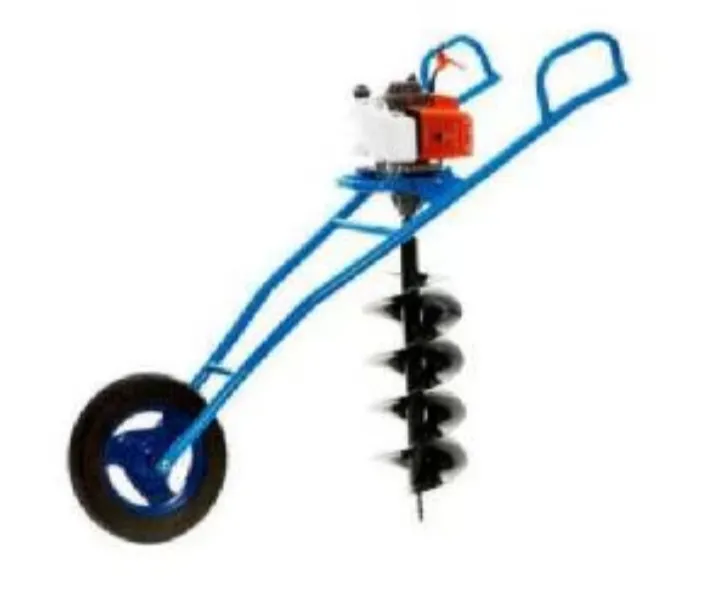
An auger uses a rotating helical bit to cut into the ground and lift loosened material toward the surface. Depending on the model, it may be operated manually with engine assistance, mounted on agricultural equipment, or attached to compatible machinery.
Augers are commonly used for:
- Fence-post installation
- Tree and sapling plantation
- Agricultural pole placement
- Signpost foundations
- Soil sampling
- Landscaping work
- Selected construction applications
Because the cutting diameter remains consistent, an auger can produce more uniform holes than repeated manual excavation.
Comparing Speed and Labour Requirements
When only a few holes are needed, the time required to arrange and position an auger may not provide a major advantage. Manual tools can be sufficient for light, occasional work.
For repetitive digging, an auger generally offers better productivity. One trained operator with suitable assistance may complete multiple holes in the time a manual team needs for a smaller number.
Actual performance depends on soil composition. Loose or moderately firm soil is usually easier to drill. Rocky ground, buried debris, roots, and highly compacted layers can slow the process or require a specialised bit.
Accuracy and Finished Results
Manual digging may create irregular edges, particularly when workers encounter hard sections of ground. An auger produces a defined circular hole, making it useful where posts, poles, or plants require consistent spacing and depth.
Accuracy still depends on correct positioning. The machine must remain stable and properly aligned as drilling begins. Operators should mark every location before starting and confirm the required diameter and depth.
Safety Considerations for Both Methods
Manual excavation presents risks such as muscular strain, hand injuries, and accidental contact with underground services. Augers reduce some physical effort but introduce rotating machinery hazards.
Before drilling, teams must inspect the area for water pipelines, electrical cables, drainage systems, and communication lines. Loose clothing should be avoided, and operators must never clear soil from a rotating bit by hand.
Which Option Is More Cost-Effective?
Cost should be evaluated against total project output rather than the equipment expense alone. Manual digging may be economical for occasional shallow holes. An auger becomes more practical when the work is repetitive, labour-intensive, or time-sensitive.
Contractors and farm owners in Nagpur should consider labour cost, project duration, fuel use, transport, expected utilisation, and maintenance requirements before deciding.
For guidance on selecting an auger suited to your soil condition and application, speak with Nagpur Agricultural Equipment Engineers Pvt. Ltd and discuss the drilling depth, diameter, and expected workload before making a purchase.
Keywords