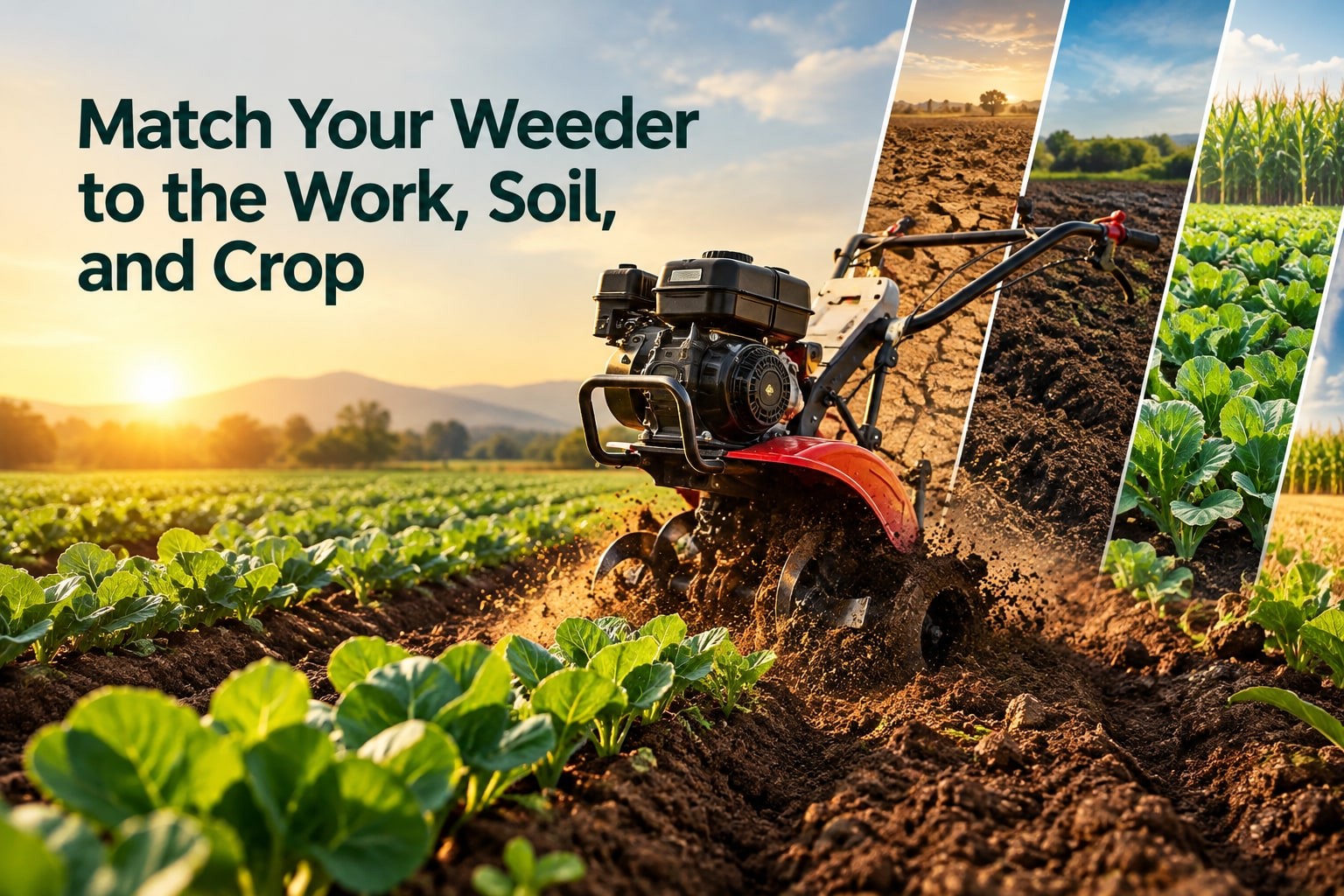
The right choice depends less on the diesel engine label than on your soil moisture, crop spacing, annual acreage, required depth and access to service. By comparing those conditions with the machine’s actual field capacity, attachments, running costs and alternatives, you can decide whether ownership will save time or create another maintenance burden.
Key takeaways
- Measure row spacing against the rotor and implement width before buying.
- Match working width and daily capacity to your actual cultivated acreage.
- Choose horsepower, wheels and control effort as one operating package.
- Compare ownership costs with hired field work and tractor access.
Start with the job, soil and crop
An Angad diesel power weeder suits shallow cultivation, intercultural weeding and seedbed preparation on small to medium plots where crop rows are accessible and the soil is workable. Measure the rotor or implement width against row spacing before buying; a machine that cannot pass without striking stems is unsuitable, regardless of engine power.
| Job | Field condition that suits it | Where to stop or use caution |
|---|---|---|
| Intercultural cultivation | Straight, sufficiently wide rows with visible clearance around plants | Avoid tight rows, spreading crops or low branches that the operator cannot see |
| Weed control | Soil loose enough for shallow blade work and weeds still small | Do not use it as a substitute for hand removal beside fragile stems |
| Seedbed preparation | Previously opened land needing fine, shallow working | Do not assume it replaces deep ploughing or heavy residue incorporation |
| Light land preparation | Level or gently sloping plots without buried stones or thick roots | Steep, rocky or continuously commercial work demands a different assessment |
Black cotton soil around Nagpur changes the decision. Work it when it crumbles; wet soil smears onto blades and dry soil can become hard enough to reduce progress, increase vibration and strain the drive.
Before choosing, check these conditions on your own field:
- Run a demonstration in the actual crop spacing and soil moisture.
- Test turning space at headlands and clearance around plants.
- Check slopes, stones, roots and access for loading the machine.
- Reject a purchase if the required attachment cannot perform the stated job safely.
Match the machine’s working figures to your acreage
A 5 HP machine is not automatically adequate for five acres, and an 8 HP machine is not automatically faster. For an Angad diesel power weeder for farm operations, calculate usable field capacity from effective width and forward speed: width in metres × speed in kilometres per hour ÷ 10 gives theoretical hectares per hour.
Reduce that figure for turning, overlap, refuelling and blocked blades before estimating a day’s output.
| Specification | 5 HP machine | 8 HP machine |
|---|---|---|
| Rotary or PTO rating | Confirm rated output under load | Confirm rated output under load |
| Working width | Match to row spacing and turning room | A wider attachment can cover more ground only if traction remains steady |
| Tilling depth | Check depth for the intended crop or seedbed | Check whether torque holds that depth in hard soil |
| Gear reduction and speeds | Look for a low gear that prevents wheel spin | Look for low-speed torque, not only maximum speed |
| Blade configuration | Verify blade count, shape and replacement cost | Verify whether the rotor can carry the wider or heavier attachment |
| Fuel tank and consumption | Calculate refuelling interruptions | Compare consumption at the actual working load |
| Operating weight | Easier loading and turning | More traction, but greater transport and operator effort |
Measure output on your own plot, not from the brochure. Record hectares completed in one hour, then multiply by the hours you can work without exhausting the operator.
Choose the 8 HP model when the 5 HP machine loses speed, slips, leaves unworked strips or cannot maintain depth; choose the lighter model when narrow rows, frequent turns and distant fields make transport the limiting cost.
Choose horsepower, wheels and control effort together
Choose the 5 HP model for lighter implements, tighter turning and lower hourly fuel demand; choose the 8 HP model when traction and implement capacity matter more than compact handling. Compare the complete machine, not the engine badge.
| Model | Traction and implement choice | Fuel, turning and fatigue |
|---|---|---|
| 5 HP | Suits lighter rotary tools and moderate soil resistance. Its lower weight can reduce grip in hard ground, especially with narrow or shallow tyres. | Usually uses less fuel per hour and takes less effort to turn or lift, but repeated passes in resistant soil increase work time and operator fatigue. |
| 8 HP | Gives more reserve for wider or heavier implements, provided the gearbox reduction, rotary output, working width, blade set and maximum depth support that load. | Usually consumes more fuel per hour and demands more effort at headlands, but fewer passes can reduce fatigue when the soil is difficult. |
| Either | Judge traction from tyre size, tread, machine weight, weight distribution and low-speed gear reduction. | Confirm the rated rotary or PTO performance; two machines with the same horsepower can behave differently. |
The Angad 8 HP power weeder is not automatically the better choice. A heavy machine becomes tiring on small, closely planted plots if you must turn it repeatedly, while a 5 HP machine wastes time when it spins, stalls or needs multiple passes.
Test both with the intended attachment in your soil moisture and crop rows, then check whether transport wheels, loading arrangements and local repair support match your farm.
Calculate whether ownership beats other field-work options
Start with annual hours, not horsepower. Calculate ownership cost per season: purchase cost, finance, fuel, servicing, repairs and the operator’s time divided by realistic annual hours. Compare that figure with custom-hire charges, including transport and waiting time. Ownership wins when it completes work on your dates and avoids repeated hiring.
| Option | Better choice when | Main limitation |
|---|---|---|
| Angad 8 HP diesel power weeder | Seedbed preparation, interculture and weed control on small-to-medium plots | Not a tractor substitute for deep primary tillage or continuous commercial work |
| Tractor cultivator | Large open fields, deep tillage and residue incorporation | Poorer access between close rows; hire or ownership cost can be high for small areas |
| Mini tiller | Light soil and short, frequent jobs near the homestead | Less traction and output in hard soil |
| Brush cutter | Grass, edges and irregular patches | Does not prepare a seedbed or cultivate soil between rows |
| Manual labour | Narrow rows, vines, shallow-rooted crops or spot weeding | Labour availability and repeat cost limit acreage |
| Custom hiring | Occasional heavy work | Scheduling, transport and soil-timing delays |
Before buying, check these figures against your farm:
- Use effective width multiplied by forward speed, then subtract turning, overlap, refuelling and blockage time. The result is your actual field capacity.
- Choose ownership when annual work hours cover the machine’s cost and the dealer can supply parts and trained service nearby.
- Reject the purchase if rows are too narrow, terrain prevents safe control, or the nearest repair support makes downtime expensive.
Use a farm-specific demonstration before buying
A field trial in your own soil is the strongest buying test. An Angad power weeder in Nagpur should work in the crop, row spacing and moisture condition you will actually face, not only on a dry showroom floor.
1. Ask the commercial power weeder dealer to run it in your field. Test cold starting, clutch engagement, forward and reverse movement, headland turns, emergency stopping, vibration, blade blockage clearing and operation at your intended depth.
In Nagpur’s black cotton soil, wet ground can smear while dry ground can become too hard; test when the soil is workable.
2. Check crop clearance at the growth stage when you will weed. Confirm the machine can pass between rows without burying plants, and watch whether the working width forces repeated hand-finishing near beds, trees or field edges.
3. Obtain written confirmation of rated power, working width, maximum recommended depth, rotor or blade configuration, included attachments, warranty exclusions and the exact fuel and service requirements. For an Angad 8 HP model, verify the rotary output and gear reduction rather than accepting “8 HP” as the performance guarantee.
4. Confirm local spare-part stock, trained service access, response time and transport arrangements. Ask whether wheels or a trailer setup are included, then measure how the machine will be loaded if your farm is far from the service centre.
Nagpur Agricultural Equipment Engineers Pvt. Ltd. can help make those checks practical by arranging advice around local soil and service access; treat the demonstration record, not showroom availability, as your evidence.
Related items
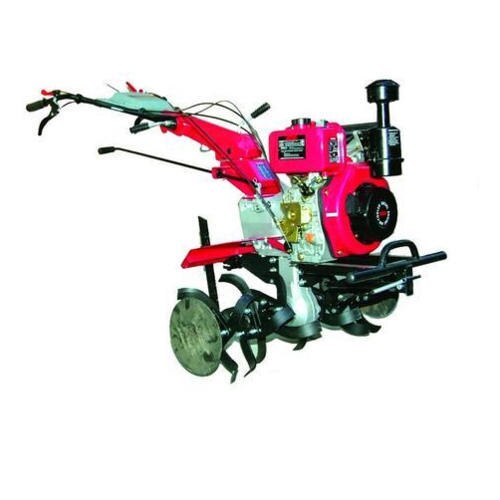 | Angad Power Weeder Angad Power Weeder ( Diesel Hull ) Fuel Type Diesel Power 5HP Type Farm Cultivator Transmission Gear Product Description We are the prominent company that is engaged in providing high... |
 | ₹95000 Angad 8 HP Diesel Power Weeder/Tiller Equipped with 8 HP Aircool Diesel Engine Reverse/Forward Gears Comes with Rubber tires, Steel Tires and... View product → |
Frequently asked questions
What farm jobs suit an Angad diesel power weeder?
Use it for shallow cultivation, intercultural weeding and seedbed preparation where crop rows are accessible and soil is workable.
How do I check whether a power weeder fits my crop rows?
Measure the gap between rows, then compare it with the rotor or implement width and allow clearance for stems.
Is an Angad 8 HP power weeder suitable for every farm?
No. Choose horsepower alongside soil condition, working width, acreage, wheel setup and the physical effort required to control the machine.
How can I compare ownership with other field-work options?
Add the purchase price, fuel, maintenance, repairs, operator time and downtime, then compare the total with hired labour or tractor work.
Why arrange a farm-specific demonstration before buying?
A demonstration lets you test row clearance, turning space, traction, depth control and operator effort in your own soil and crop.
Keywords