
A KSMB pump can serve a factory, shop, office building or storage system only when its actual flow, head, water quality and electrical supply match the site. By the end, you will be able to identify suitable duties, calculate the required pump point, check 220 V or 440 V installation needs, and reject an unsuitable clean-water pump before purchase.
Key takeaways
- Use KSMB pumps for relatively clean-water transfer, tanks, buildings and small irrigation.
- Calculate flow and total dynamic head before comparing pump models.
- Match the motor voltage with the available electrical supply and installation requirements.
- Confirm water quality, temperature, casing material and service access before ordering.
Which Nagpur business duties suit a KSMB pump?
A KSMB pump suits relatively clean-water transfer more readily than heavy process duty. Typical KSMB stainless steel pump uses include moving water from a sump, underground tank or storage vessel to an overhead tank, supplying a small commercial building, filling utility tanks, and irrigating a garden or small agricultural plot.
| Duty | KSMB fit | Check or alternative |
|---|---|---|
| Tank transfer | Suitable for intermittent transfer of clean water | Confirm flow, head, connection size and motor duty |
| Utility-water distribution | Suitable for small commercial premises | Check pressure at the farthest outlet |
| Washdown | Suitable for short, clean-water washdown cycles | Confirm run time and required pressure |
| Cooling-water circulation | Possible for clean, non-corrosive water | Confirm continuous duty, temperature and circulation flow |
| Process-water boosting | Possible only after duty confirmation | Match the pump curve to flow, head and operating hours |
| Muddy or abrasive water | Poor choice for sand, silt or debris | Use a dewatering or solids-handling pump |
A kirloskar water pump for industrial premises must match the process rather than the label. Continuous factory circulation, frequent washdown, or repeated tank filling can overheat a domestic-style monoblock unless its duty cycle is confirmed from the model documentation.
Check the nameplate and manufacturer’s performance curve; KSMB variants differ in motor power, impeller, phase, head, discharge and connection size. Stainless steel resists ordinary water corrosion, but chloride-rich, stagnant or chemically contaminated water can cause pitting, while Nagpur’s hot enclosures demand shade and ventilation.
How do you select the required flow and total dynamic head?
Required flow is the water volume the system must deliver; total dynamic head (TDH) is the resistance it must overcome. A Kirloskar KSMB stainless steel water pump for applications in Nagpur must be selected for both figures at the same operating point, not by motor horsepower alone.
1. Record the target flow in litres per minute or cubic metres per hour. Base it on the duty: tank filling, washdown, process supply, cooling circulation or irrigation. Include simultaneous outlets and the required operating hours.
2. Measure the vertical difference between the source-water level and the delivery point. Add suction lift from a low source to the pump centreline, or subtract flooded-suction height where the source stands above the pump.
3. Calculate pipe losses using the pipe’s internal diameter, total length and material. Add the resistance from every elbow, tee, check valve, foot valve, filter and partially closed isolation valve. A narrow or excessively long pipe can consume more head than the elevation.
4. Convert outlet pressure into head. One bar equals approximately 10.2 metres of water; therefore, 2 bar requires about 20.4 metres before pipe losses are added.
5. Add elevation, suction and discharge losses, plus outlet-pressure head, to obtain TDH. Check the manufacturer’s performance curve for the exact KSMB variant, impeller, phase and connection size. Read the flow at that TDH, not the zero-flow maximum head.
If the curve misses your required flow at the calculated TDH, choose another variant or revise the pipework. Confirm suction conditions and avoid a duty that causes cavitation, dry running or continuous overload.
How should you match 220 V or 440 V power to the installation?
A 220 V nameplate usually indicates single-phase operation, while a 440 V motor requires a compatible three-phase supply. Do not select by horsepower alone: check the KSMB nameplate for voltage, phase, frequency, full-load current and permissible operating conditions.
A Kirloskar water pump for industrial premises needs the pump curve, cable, starter and protection to match the same duty.
1. Confirm the site supply with a qualified electrician. Measure voltage at the proposed panel, verify frequency, check earthing and insulation resistance, and confirm phase sequence for a three-phase motor. A 440 V motor connected to a 220 V circuit will not run correctly; the wrong phase connection can damage the motor.
2. Choose a motor starter rated for the motor current and starting method. Use a DOL starter for suitable smaller motors, or a star-delta starter or soft starter when starting current and voltage drop require control. Fit short-circuit protection and set the thermal overload relay to the motor nameplate current, not an estimated value.
3. Size copper or aluminium cable from full-load current, cable length, installation temperature, grouping and permitted voltage drop. An undersized cable overheats and causes low-voltage starting trips.
4. Add a float switch, level controller or pressure controller with dry-run protection. Match its contacts and controller to the motor circuit.
5. Keep the suction pipe short, straight and at least the pump connection size; avoid unnecessary elbows. Fit an accessible foot valve where suction lift requires retained prime, but clean it regularly.
Provide shade, rain protection and cross-ventilation around the motor and panel. Nagpur summer heat inside a sealed enclosure can trigger overloads.
Can the stainless steel casing handle your water and process conditions?
A stainless-steel casing suits relatively clean water, not every liquid. Typical KSMB stainless steel pump uses include transferring water from a sump or storage tank, filling an overhead tank, supplying commercial premises and irrigating small plots.
Sand, abrasive silt and construction debris can wear the impeller and mechanical seal, while chloride-rich or stagnant water can cause pitting and crevice corrosion.
| Liquid | Casing suitability | Confirm in model documentation |
|---|---|---|
| Clean tank or municipal water | Usually the intended duty | Stainless grade, maximum temperature, pH range, permitted turbidity and solids limit |
| Muddy or abrasive water | Do not use a clean-water pump by assumption | Solids concentration, particle size and abrasion rating; choose dewatering or solids-handling equipment when needed |
| Saline or chloride-rich water | Stainless steel is not automatically corrosion-proof | Grade, such as SS304 or SS316, maximum chloride concentration and water analysis requirements |
| Chemical or treated water | Compatibility depends on the chemical and concentration | Chemical name, concentration, pH range, temperature and seal material |
| Hot water | Use only within the rated temperature | Maximum liquid temperature, motor cooling conditions and duty cycle |
| Water containing suspended solids | Risk depends on size and quantity | Maximum solids size, concentration and impeller passage |
Ask for the exact model number, nameplate and manufacturer’s curve; “Kirloskar KSMB stainless steel water pump” does not identify one specification. Obtain the permitted liquid temperature, pH, chloride or conductivity limit, turbidity, solids content, continuous-running limit and mechanical-seal material. Test borewell or process water if scaling or corrosion has occurred.
In Nagpur summer, provide shade and ventilation because an enclosed pump room adds heat to the motor and controls.
What should a Nagpur business confirm before ordering the pump?
Order only after the site record, motor details and model documents agree. A stainless steel pump for commercial water supply can fail through incorrect controls, undersized connections or an unsuitable duty cycle even when its horsepower appears adequate.
1. Record the water source, minimum and maximum tank levels, delivery-point elevation, pipe length, internal diameter, elbows, valves and required outlet pressure. State the target flow in litres per minute or cubic metres per hour, not only “high pressure.”
2. Specify the duty: tank transfer, utility distribution, washdown, cooling-water make-up or process supply. Write the operating hours per day, starts per hour and any continuous-running requirement; do not assume a domestic-style motor suits industrial service.
3. Confirm the tank arrangement and controls. A float switch or level controller should stop the pump before the source tank runs dry and prevent the receiving tank from overflowing; a pressure controller suits a pressurised distribution line. Check controller, starter and overload compatibility with the motor.
4. Match the order to the nameplate and performance curve. Confirm 220 V single-phase or 440 V three-phase supply, motor power, phase, suction and discharge connection sizes, rated head and discharge. Obtain the exact thread, flange or pipe size so reducers do not create avoidable losses.
5. Ask for the model datasheet confirming stainless-steel grade, impeller and body materials, permitted water temperature, solids limit and duty rating. For the Kirloskar KSMB stainless steel water pump for applications in Nagpur, Nagpur Agricultural Equipment Engineers Pvt. Ltd. can help verify the selection, installation requirements and service arrangements against your recorded site data.
Related product
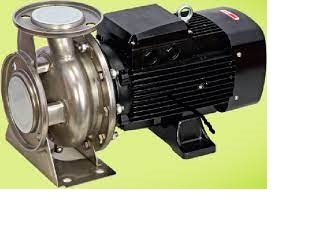 | Kirloskar Industrial Pumps Kirloskar KSMB Stainless Steel Pump Kirloskar Make KSMB MOC: Stainless Steel Volute casing and Impellar CI Body Available in 220 and 440 volts View product → |
Frequently asked questions
Which Nagpur business duties suit a KSMB pump?
KSMB pumps suit relatively clean-water transfer from sumps, underground tanks or storage vessels to overhead tanks, utility tanks, buildings and small irrigation systems.
How do you select the required flow and total dynamic head?
Set flow from the required delivery rate, then add static lift, pipe friction, valves and outlet pressure to calculate total dynamic head. Compare both figures with the pump curve.
How should you match 220 V or 440 V power to the installation?
Check the pump motor nameplate against the site supply, phase arrangement, starter, cable size and protection. Ask an electrician to verify the installation before connection.
Can the stainless steel casing handle your water and process conditions?
Check water cleanliness, chemical content, temperature, solids and corrosion risk against the exact KSMB model materials and operating limits. Stainless steel does not make every pump suitable for process fluids.
What should a Nagpur business confirm before ordering the pump?
Confirm the duty point, voltage, phase, pipe size, installation location, water condition, motor protection, warranty terms, spare parts and local service support.
Keywords